Typed version (MathJax)
This section follows the Week 5 notes in order. The full original notes appear below, page by page.
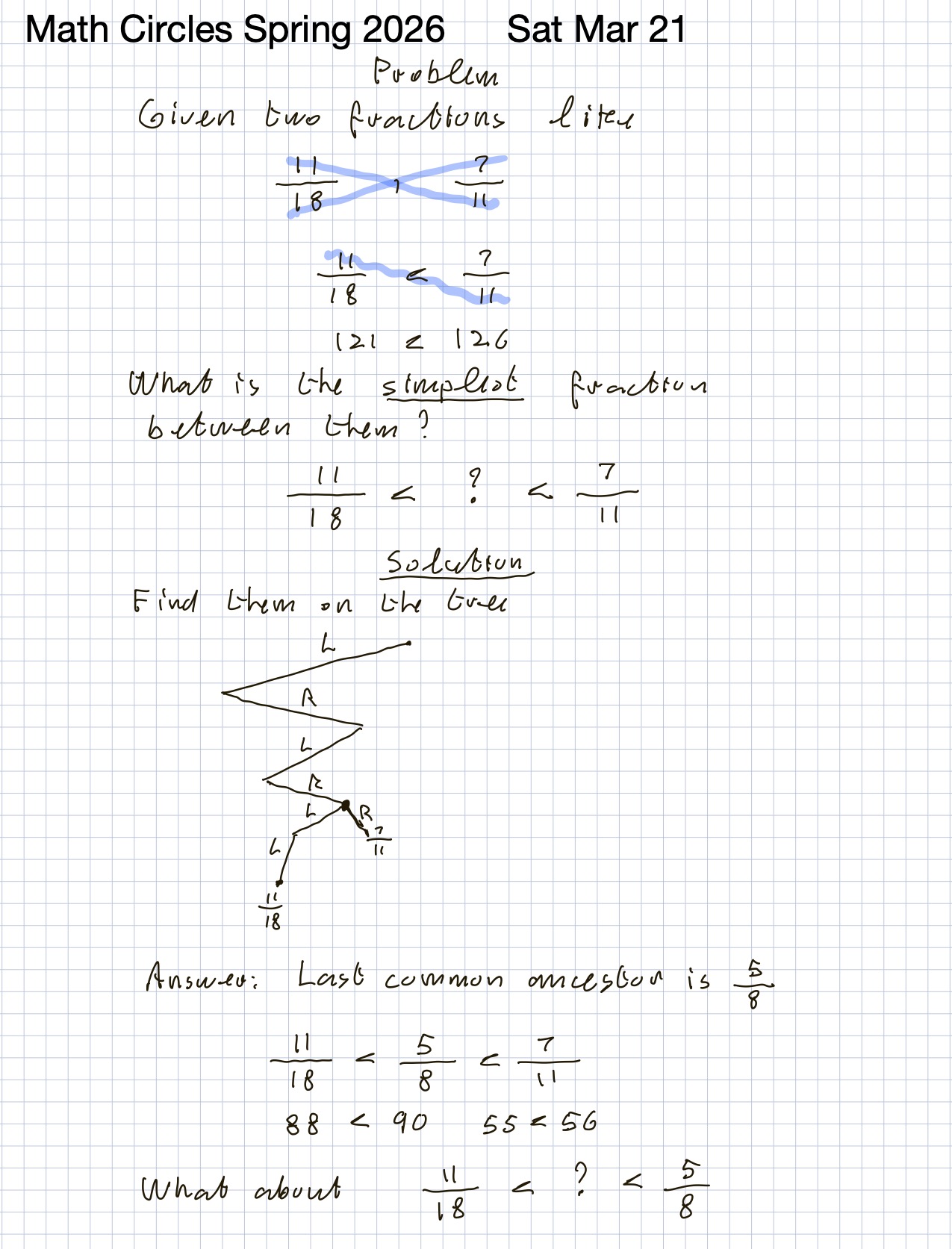
Problem: the simplest fraction between two fractions
We begin with the problem of finding the simplest fraction between two given fractions. The first example is
We solve this by locating both fractions on the Stern–Brocot tree and taking their last common ancestor. The answer shown is
Cross-multiplication confirms it: \[ 88 < 90,\qquad 55 < 56. \]
A second example using overlap
Then we ask what happens between \(\tfrac{11}{18}\) and \(\tfrac{5}{8}\).
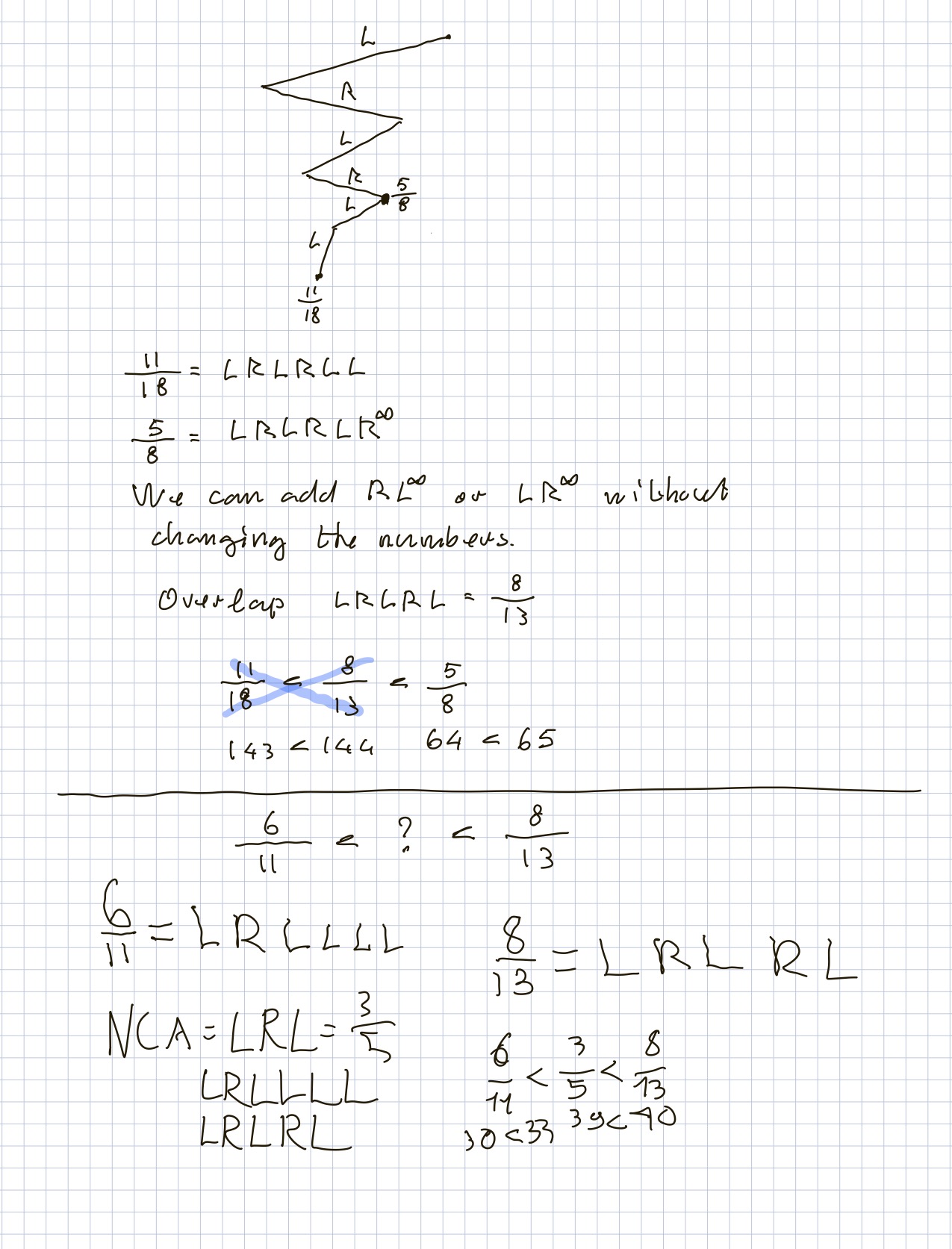
Using Stern–Brocot paths, we write
Since we may append \(R^\infty\) or \(L^\infty\) without changing the represented number, the longest overlap is
So we conclude
Another example with nearest common ancestor
The next example asks for a fraction between
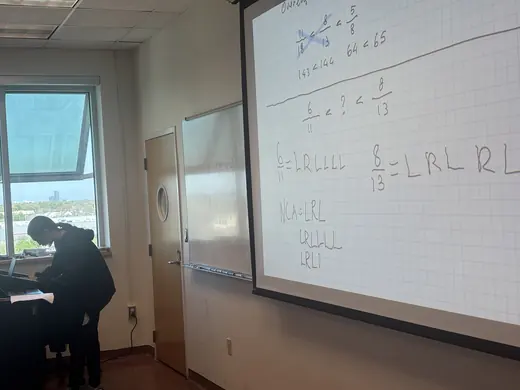
We record the Stern–Brocot descriptions \[ \frac{6}{11} = LRLLLL, \qquad \frac{8}{13} = LRLRL, \] and identify the nearest common ancestor \[ LRL = \frac35. \]
Hence
A number-theoretic fact
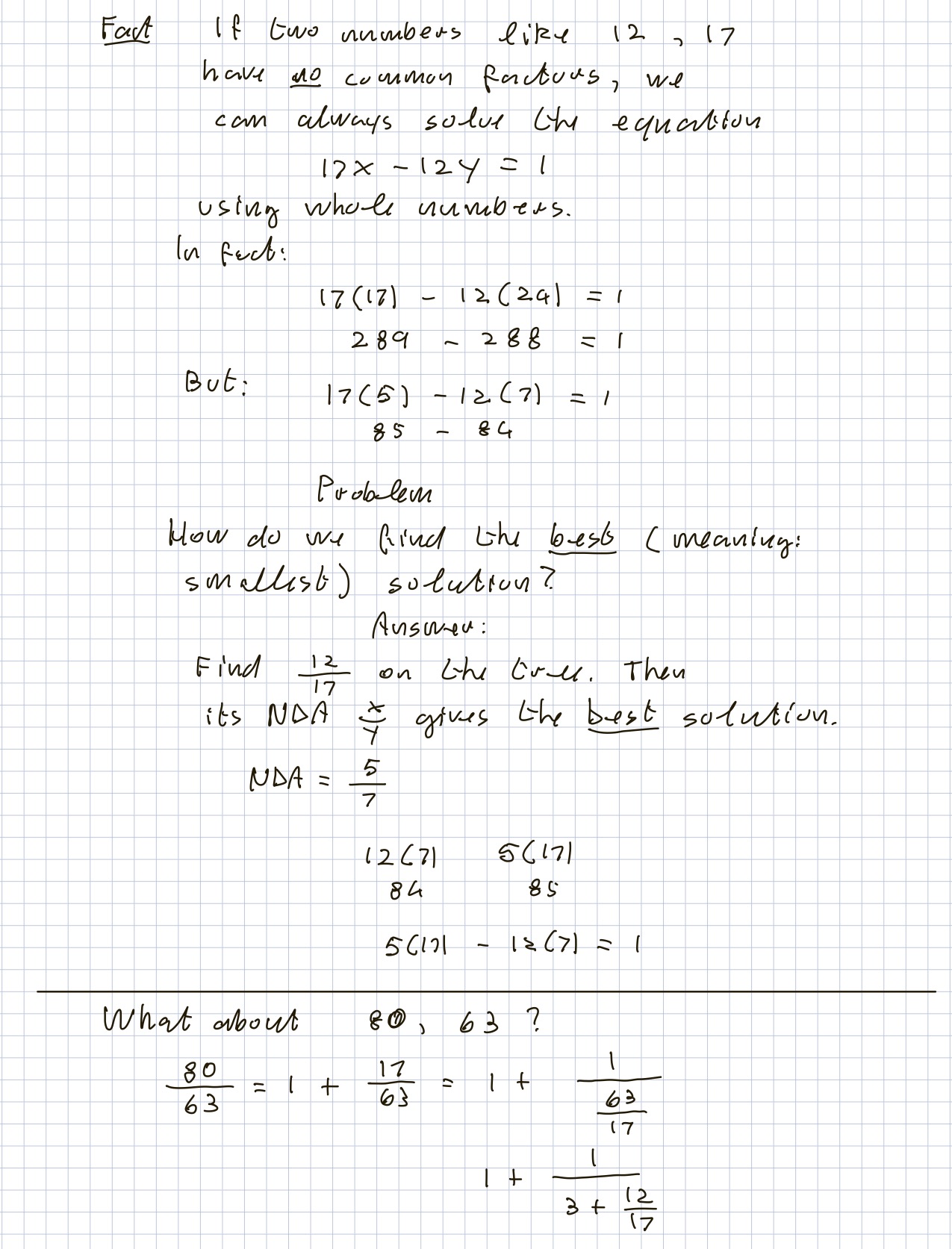
We now switch to a Diophantine equation viewpoint. If two integers such as \(12\) and \(17\) have no common factors, then we can solve
using whole numbers. One example given is
But this is not the smallest solution, since
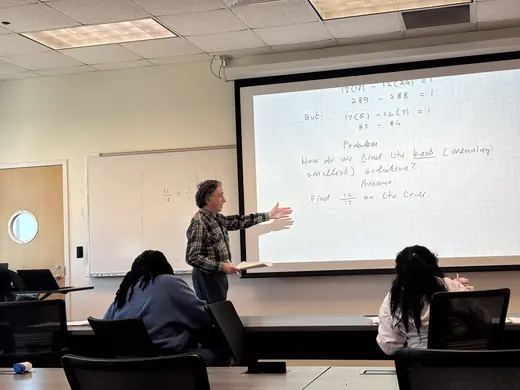
Problem: find the best (smallest) solution
We ask:
The answer given is: find \(\tfrac{12}{17}\) on the Stern–Brocot tree; then its NDA gives the best solution.
Then \[ 12(7)=84,\qquad 5(17)=85, \] so \[ 5(17)-12(7)=1. \]
Example: \(\frac{80}{63}\)
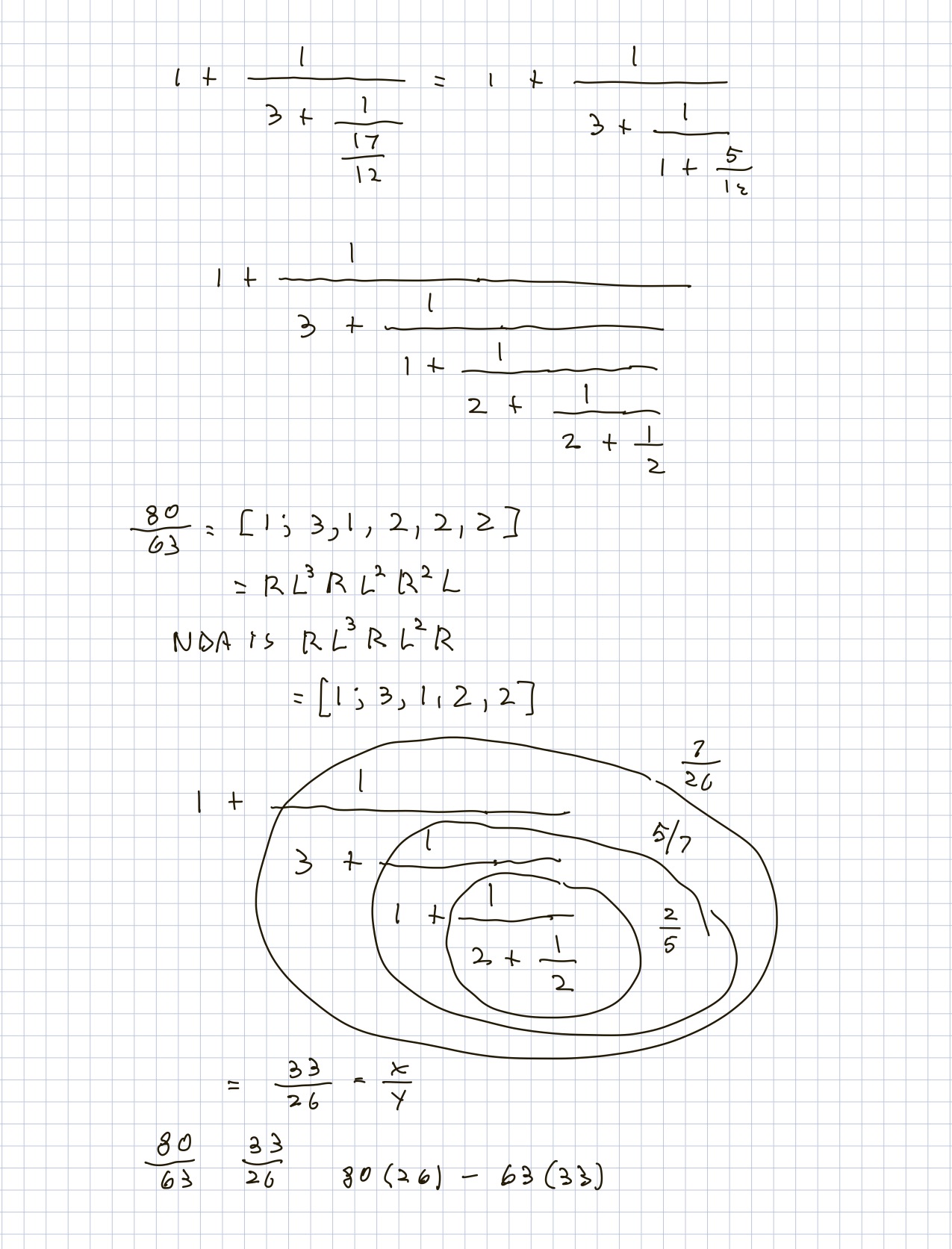
The last two pages work out the same idea for \(\tfrac{80}{63}\). First we express it as a continued fraction:
We then translate this into a Stern–Brocot path:
The NDA is obtained by removing the last block, plus one more letter, giving
Computing the NDA fraction
We evaluate
Therefore the best solution is given by
Main idea
Week 5 ties together two viewpoints:
- the Stern–Brocot tree and continued fractions for finding the simplest fraction between two others,
- the same machinery for finding the smallest positive integer solution to equations of the form \[ ax-by=1 \] when \(a\) and \(b\) are relatively prime.
The key recurring object is the nearest distant ancestor (NDA).
Photo Gallery
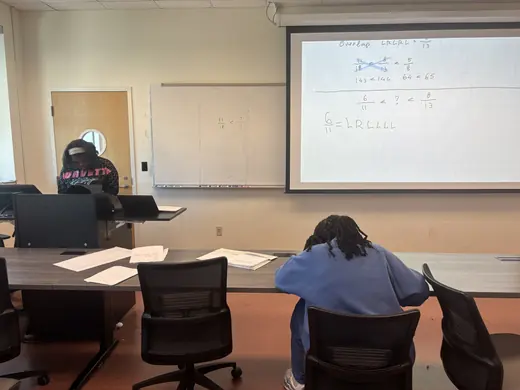
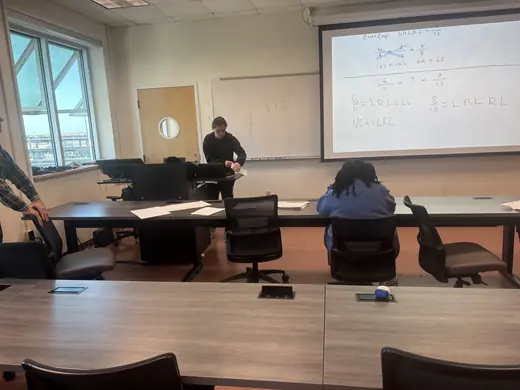
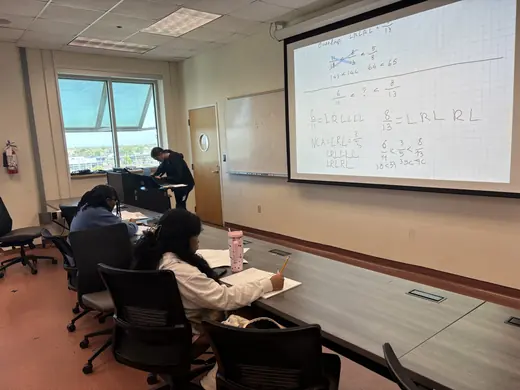
Photos from Week 5 Math Circles. Scroll horizontally, or click any photo to enlarge it.
Week 5 Photos
Full notes (all pages)
These are the complete Week 5 notes, included in full at the end.