Photo gallery
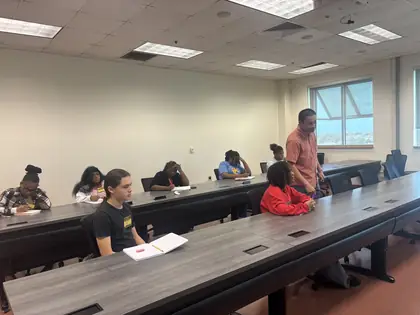
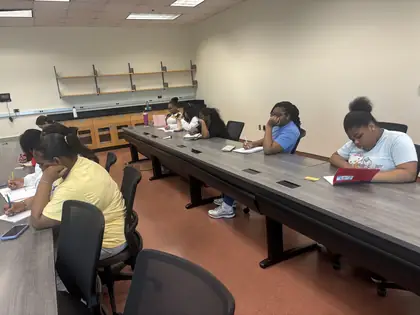
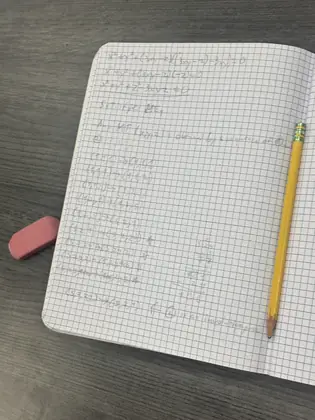
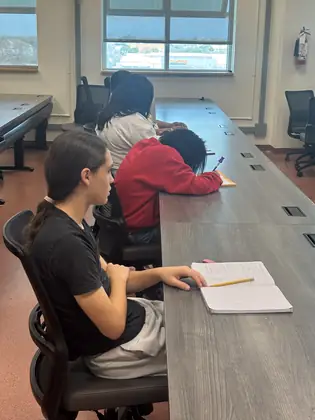
Week 1 photos

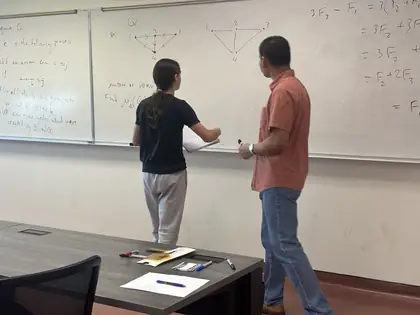
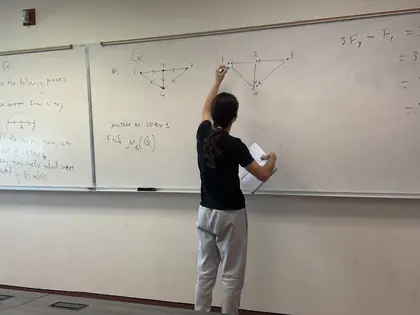
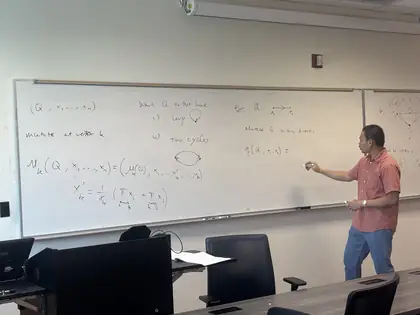
1) Markov triples (M.T.)
A triple of positive integers \((x,y,z)\) is called a Markov triple if it satisfies the Markov equation
Any integer appearing in a Markov triple is called a Markov number.
Examples
- \((1,1,1)\) since \(1^2+1^2+1^2=3=3\cdot1\cdot1\cdot1\).
- \((1,1,2)\) since \(1^2+1^2+2^2=6=3\cdot1\cdot1\cdot2\).
Exercise
Check that the following are Markov triples:
\[ (1,2,5),\quad (1,5,13),\quad (2,5,29),\quad (1,13,34). \]
Historical note. Markov triples were studied by A. Markoff (late 1800s). In 1913, Frobenius conjectured a “uniqueness” property: roughly, that the largest entry in a Markov triple determines the other two (up to permutation). The full conjecture remains open, with partial progress via cluster-algebra methods.
2) Properties of Markov triples
Two natural questions:
- Can we obtain a new Markov triple from a given one?
- How many Markov triples are there?
Move (1): permutation
If \((x,y,z)\) is a Markov triple, then any rearrangement is also a Markov triple (symmetry).
Example. From \((1,2,5)\), we get
\[ (2,1,5),\ (2,5,1),\ (1,5,2),\ (5,1,2),\ (5,2,1). \]Move (2): a Vieta-type involution
Start from the Markov equation and isolate the \(z\)-dependence:
Define a new integer
Then \((x,y,z')\) is also a Markov triple (a “Vieta move”).
Using Moves (1) and (2), build a chain of Markov triples starting from \((1,1,1)\). (Optional: look for patterns related to Fibonacci numbers.)
3) Mutation of a quiver
A quiver is a directed graph (vertices + arrows). In this context we exclude:
- loops (an arrow from a vertex to itself),
- 2-cycles (a pair of opposite arrows between two vertices).
Let \(Q\) be a quiver with vertices \(1,2,\dots,n\). Mutation at a vertex \(k\), denoted \(\mu_k(Q)\), is defined by:
- If there is a path \(i \to k \to j\), add an arrow \(i \to j\).
- Reverse all arrows incident to \(k\).
- Delete any 2-cycles created by the previous steps.
This mutation process is central in cluster algebra theory; in modern treatments, Markov triples can be studied via repeated mutations of a 3-vertex quiver.